RSS Meets LLM: Database Schema Evolution (Part 2)
Sep 2, 2026Part 2 of a 4-part series on how EnggFeed, an RSS + LLM engineering blog aggregator, is built. Part 1 covered how it’s built.
Note: the video above shows all 13 tables together, the 10 live ones plus the 3 that were dropped along the way (user, allowed_users, blog_chunk). This isn’t the schema at any single point in time, it’s the full picture. Later migrations changed things from there, walked through below.
Initial Commit Details
While I was ideating on building enggfeed, the core premise was to build an engineering systems blog aggregator that runs on top of RSS feeds. However, as the core involved making direct LLM calls, I decided to have a sign up with Google feature. Without Sign Up, one can only browse the feed, filter by company. Once logged in, they can access pre-requisites, tags, summary, explain like I am 5 for each blog, and user feedback.
This led to the decision of having user, allowed_users tables. As this was Google sign up, I further wanted to make the users invite only, just to ensure no misuse. If a user’s email is already present in the allowed_users email list, then the user gets added to the user table.
All the blogs on the platform are parsed from RSS feeds of individual tech companies. Due to this, it was required to store the RSS feed links of each source. Added blog_source table for the same. It has rss_feed_link, source. For each item in the feed, we extract guid, published_at, link, word_count, title, created_at, blog_source_id, thumbnail. All these fields are stored in the blog table. blog_source_id is a foreign key referencing blog_source.id, tying each blog back to the source it was ingested from. In the initial design, I had added a search feature. For the same reason, the blog_chunk table was added with fields blog_id, chunk_text, embedding.
Each blog will further have summary, simplify, prerequisites. So, summary, simplify, prerequisite, tag, blog_tag, blog_prerequisite were also part of the initial commit.
The blog table to summary table has a 1:1 relationship. There can only be one summary associated with one blog. summary has the following fields id, blog_id, content, created_at, updated_at. blog_id is a foreign key referencing blog.id. The blog table to simplify table has a 1:1 relationship. Corresponding to each blog, there will be only one simplify, and simplify.blog_id is likewise a foreign key referencing blog.id.
Each blog can have multiple prerequisites, each prerequisite can be present on multiple blogs. This resulted in a many-to-many relationship between blog and prerequisite. The prerequisite table has id, created_at, updated_at, content, embedding, topic_name.
Whenever there is a many-to-many relationship between 2 tables, as per database design fundamentals, there needs to be an intermediary table.
blog_prerequisite was created. blog_prerequisite stores blog_id, prerequisite_id, both foreign keys, referencing blog.id and prerequisite.id respectively, together forming the composite primary key.
Similarly, one blog can have multiple tags, and a tag can be present on multiple blogs. This is a many-to-many relationship. Created an intermediary table, blog_tag. blog_tag stores blog_id, tag_id, both foreign keys, referencing blog.id and tag.tag_id respectively, together forming the composite primary key. Initial migration contained all these core tables. The tag table has
tag_id, created_at, tag, embedding.
What Changed After Launch
On thinking and iterating further from a user’s point of view, I realized that once blogs are aggregated on a platform, it is no longer a search problem. Given blogs from many companies, no one knows the blog titles beforehand, so what would they even type into a search box? It is a discovery problem instead. Due to this, in the next migration blog_chunk table was dropped.
As summary, simplify, tags, prerequisite, prerequisite_content are all LLM-dependent, there is always a likelihood of hallucination. To get human review on the AI generation, I decided to provide a feedback form. Later, this can also help improve the quality further. Due to this, the feedback table was added in the next migration. Feedback has id, blog_id, user_id, type, content, created_at. blog_id is a foreign key referencing blog.id, and at this point user_id was also a foreign key referencing user.user_id. Possible values of type are tag, prerequisite, summary, simplify. type is an enum.
I did the initial run locally. Things looked fine from a product point of view. I went ahead with deployment. I reached out to some of my friends, took their email ID. Added them as allowed_users. Only to find out later. They may have just browsed and dropped off. As money was at stake. I was still hesitant to remove auth fully, so to begin with I decided to drop allowed_users table. This meant any user having a Gmail account can sign up.
Continued to run the project for some months. Only to realize that sign up is only adding friction. No sign ups. Took the call to drop the guards. Remove auth from the platform. This led to dropping the user table and dropping feedback.user_id. Since there were no real sign-ups, there was no actual user data to worry about, so this was a clean break rather than a migration needing careful rollback or data-preservation handling.
The user table was helping in tracking who the feedback was by. As a workaround, added optional name, email fields in the feedback table and form.
As features relying on the LLM were no longer gated, and articles were also aging out of the RSS feed’s rolling window before an on-demand fetch could reach them, all LLM calls were moved to ingest time. Added the llm_usage table for detailed cost analysis per blog, with fields id, blog_id, call_type, provider, model, input_tokens, output_tokens, total_tokens, cost_usd, created_at. blog_id is a foreign key referencing blog.id. Possible values of call_type are tag_prerequisite_extraction, summary, simplify, tag_embedding, prerequisite_embedding, prerequisite_content.
Seven migrations in: the initial migration created 11 tables covering auth, search, and every feature I could think of on day one. user, allowed_users, and blog_chunk were dropped along the way, and feedback and llm_usage were added later, landing at 10 tables today, all of them there because something is actually being used. Across the whole history, that’s 13 distinct tables total, the 10 live ones plus the 3 dropped. Here’s the current schema:
The Schema Today
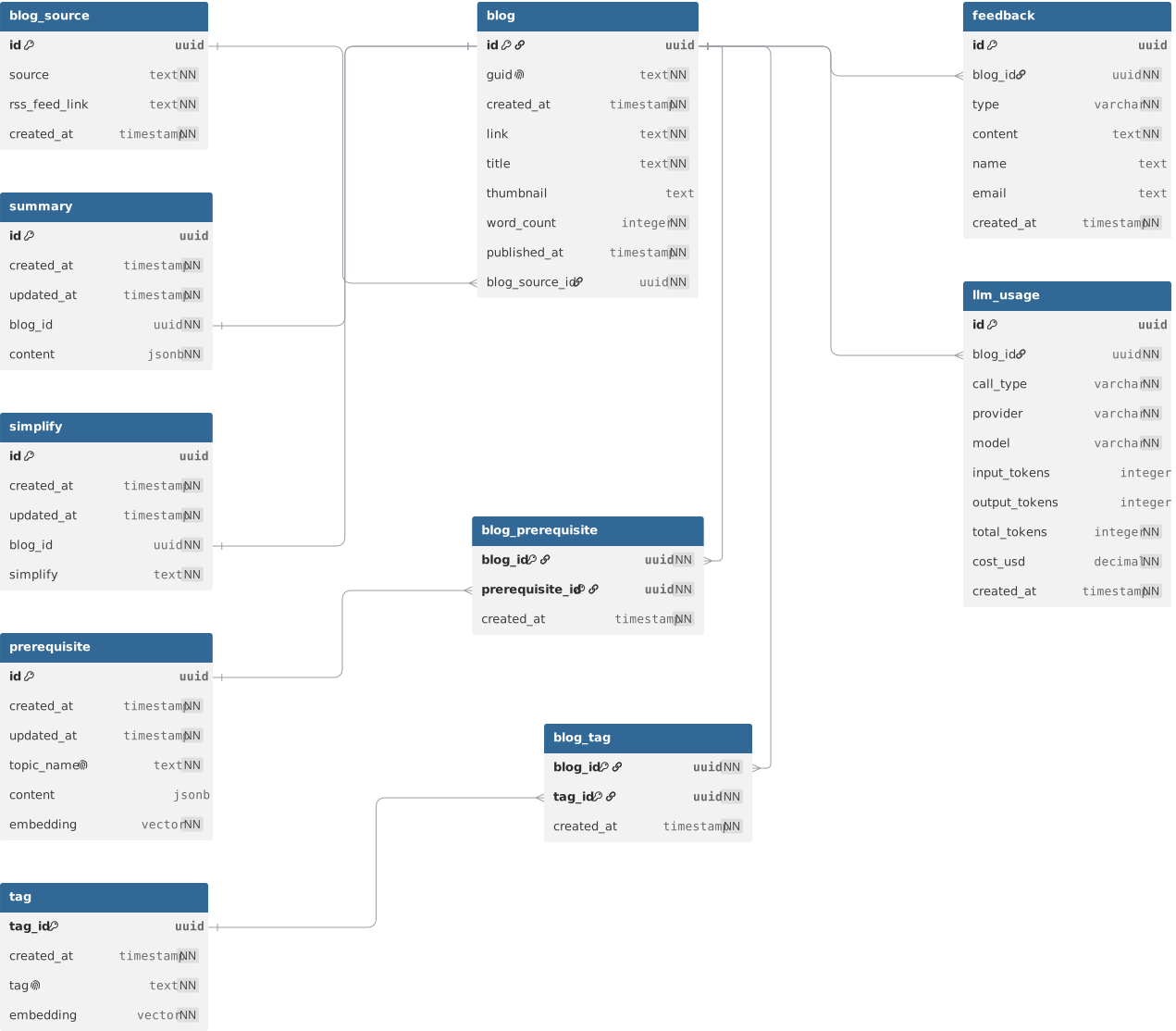
Click to view full size · browse all migrations on GitHub
One design choice from the very first migration, keeping blog.id as an internal UUID separate from the RSS guid, ended up mattering more than expected. More on that in Part 3.
Coming up in Part 3: the real bugs this schema ran into in production, and the tradeoffs (LLM cost, vector store choice, async ingest) that came out of fixing them.